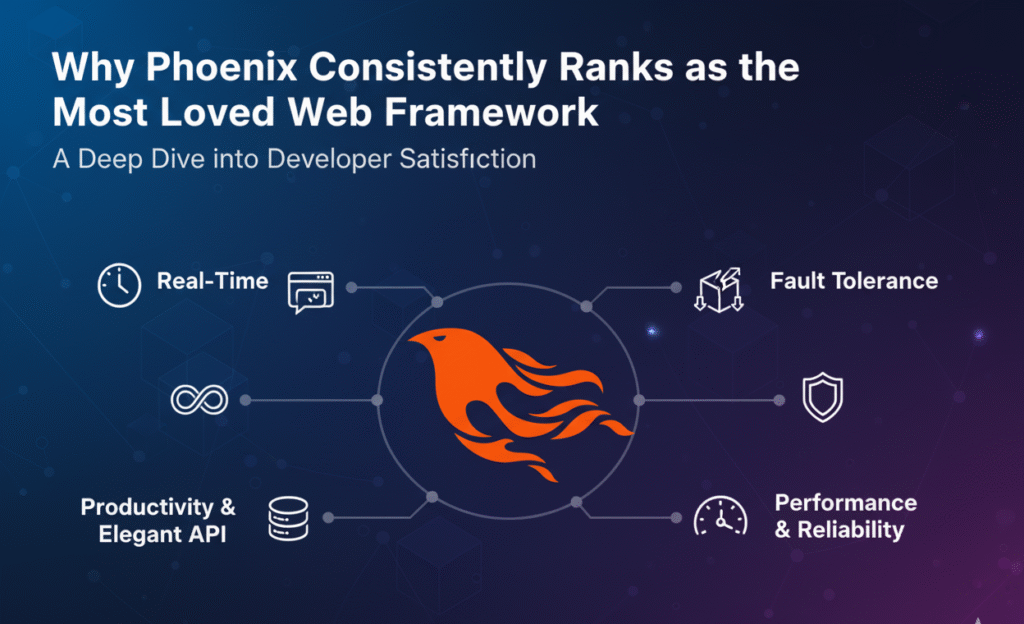
A Deep Dive into Developer Satisfaction
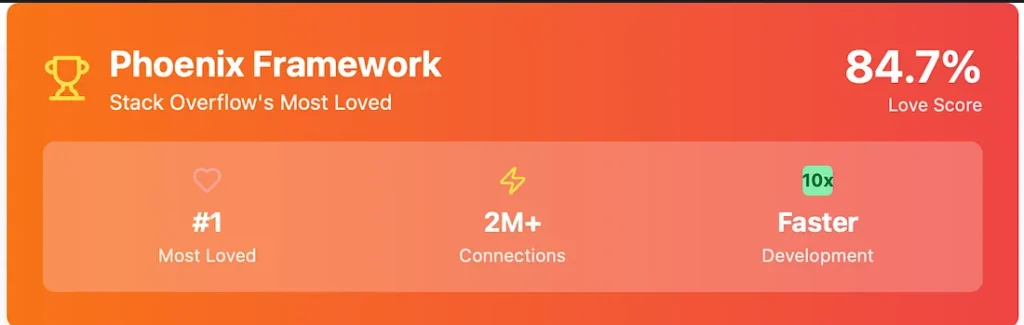
Year after year, when Stack Overflow releases its Developer Survey, one result consistently surprises people: Phoenix, Elixir’s web framework, tops the “Most Loved” web frameworks list, often beating popular choices like Express.js, Django, Spring Boot, and Go’s various frameworks.
This isn’t a fluke or a small sample size anomaly. Phoenix has maintained this position across multiple years, which raises an important question: what makes developers who use Phoenix love it so much that they consistently rate it higher than frameworks with much larger communities and ecosystems?
The answer isn’t just about performance metrics or feature lists. It’s about developer experience, architectural elegance, and solving real problems that other frameworks often struggle with.
The “Love” Factor: What Actually Drives Developer Satisfaction
Before diving into Phoenix specifically, it’s worth understanding what makes developers “love” a framework. The Stack Overflow survey asks developers which technologies they’ve worked with and want to continue working with. High “love” scores typically indicate:
- Productive development experience: Getting things done without fighting the framework
- Reliability in production: Fewer 3 AM wake-up calls
- Pleasant API design: Code that feels natural to write and read
- Solving real problems elegantly: Not just moving complexity around
Phoenix excels in all these areas, but for reasons that might not be obvious if you haven’t experienced it firsthand.
The Phoenix Advantage: Built for the Modern Web
Real-Time as a First-Class Citizen
Most web frameworks treat real-time features like WebSockets, live updates, and push notifications as afterthoughts. You typically need to bolt on additional services like Redis, message queues, or separate WebSocket servers.
Phoenix LiveView and Channels make real-time interactions feel natural:
# Real-time collaborative editing in just a few lines
def handle_event("typing", %{"content" => content}, socket) do
  broadcast(socket, "user_typing", %{content: content, user: socket.assigns.user})
  {:noreply, assign(socket, content: content)}
endCode language: Elixir (elixir)
This isn’t just convenient syntax — it’s backed by the BEAM VM’s actor model, which can handle millions of concurrent connections without breaking a sweat.
Fault Tolerance That Actually Works
Here’s something you rarely see in other frameworks: Phoenix applications are designed to recover from failures automatically. The “let it crash” philosophy means that when something goes wrong with one user’s session or process, it doesn’t affect anyone else.
In most web frameworks, an unhandled exception can potentially crash the entire server process. In Phoenix, isolated failures are contained and automatically restarted by supervisor trees.
Live Reloading for Everything
Phoenix LiveView takes the concept of hot reloading and extends it to the entire application state. You can update server-side code and see changes reflected in real-time browser sessions without losing application state.
This dramatically shortens the feedback loop during development, making the coding experience feel more interactive and immediate.
The Competition’s Pain Points
To understand why Phoenix scores so highly, it’s helpful to look at common frustrations developers face with other popular frameworks:
Node.js/Express: Callback Hell and Single-Threaded Bottlenecks
While Node.js revolutionized server-side JavaScript, developers often struggle with:
- Complex async/await chains for simple operations
- Single-threaded nature causing performance bottlenecks
- Memory leaks in long-running processes
- Difficulty handling CPU-intensive tasks
Spring Boot/Java: Complexity and Resource Consumption
Java frameworks are powerful but often criticized for:
- Heavy memory footprint and startup times
- Configuration complexity, even with “convention over configuration”
- Verbose syntax for simple operations
- Thread management becoming complex under high concurrency
Go Web Frameworks: Great Performance, Manual Everything
Go excels at performance but developers often mention:
- Having to build many features from scratch
- Verbose error handling throughout the codebase
- Manual dependency injection and configuration management
- Limited built-in tooling for common web development tasks
Phoenix’s Secret Weapons
LiveView: The Game Changer
Phoenix LiveView deserves special mention because it fundamentally changes how you think about web development. Instead of building separate frontend and backend applications, you write server-side code that automatically synchronizes with the browser.
def handle_event("increment", _params, socket) do
  {:noreply, assign(socket, count: socket.assigns.count + 1)}
endCode language: Elixir (elixir)
This simple function automatically updates the browser in real-time when a button is clicked. No API endpoints, no JavaScript state management, no complex build processes.
Pattern Matching and Functional Programming
Elixir’s pattern matching makes Phoenix code incredibly readable and maintainable:
def handle_params(%{"id" => id}, _uri, socket) when is_binary(id) do
  case fetch_user(id) do
    {:ok, user} -> {:noreply, assign(socket, user: user)}
    {:error, :not_found} -> {:noreply, redirect(socket, to: "/")}
  end
endCode language: PHP (php)
This level of expressiveness and error handling is built into the language, making complex logic feel simple.
OTP: Standing on the Shoulders of Giants
Phoenix is built on Erlang/OTP, which has been battle-tested in telecom systems for decades. This means Phoenix applications inherit:
- Proven concurrency patterns
- Fault tolerance mechanisms
- Hot code deployment capabilities
- Distributed system primitives
You’re not just using a web framework; you’re leveraging a entire ecosystem designed for building reliable, concurrent systems.
The Production Reality Check
While developer satisfaction surveys focus on the coding experience, Phoenix’s high ratings likely also reflect its production characteristics:
Exceptional Performance with Minimal Resources
Phoenix applications typically use significantly less memory and CPU than equivalent applications in other frameworks, while handling more concurrent users. This translates to lower hosting costs and fewer scaling headaches.
Debugging and Observability
The BEAM VM provides exceptional introspection capabilities. You can connect to a running Phoenix application and inspect processes, memory usage, and message passing in real-time without impacting performance.
Deployment Simplicity
Phoenix applications compile to self-contained releases that include the Erlang runtime. No complex containerization setups or dependency management in production — just copy and run.
The Network Effect of Happiness
When developers consistently have positive experiences with a framework, it creates a virtuous cycle:
- Better Documentation: Happy developers contribute better docs and tutorials
- Helpful Community: Less frustration leads to more collaborative, supportive communities
- Quality Libraries: Satisfied developers build and maintain higher-quality packages
- Knowledge Sharing: Positive experiences encourage more blog posts, talks, and learning resources
Phoenix benefits enormously from this cycle. The Elixir community is known for being welcoming, helpful, and producing high-quality educational content.
The Honest Assessment: Why Not Everyone Uses Phoenix
If Phoenix is so loved, why isn’t everyone using it? The reasons are practical rather than technical:
Learning Curve
Functional programming and the actor model represent a significant paradigm shift for developers coming from object-oriented backgrounds. While many find this refreshing once they adapt, the initial learning curve is real.
Ecosystem Size
While growing rapidly, Elixir’s ecosystem is smaller than Java, JavaScript, or Python. You might occasionally need to build something from scratch or port a library.
Hiring Challenges
Finding developers with Elixir experience can be more challenging than finding JavaScript or Java developers, though many companies successfully train existing developers in Elixir.
The Future of Web Development
Phoenix’s consistent high satisfaction ratings might be indicating something important about the future of web development. As applications become more real-time, interactive, and distributed, the architectural advantages that make Phoenix developers happy become increasingly relevant.
The web is moving toward:
- Real-time collaboration (like Figma, Notion, or Google Docs)
- Live streaming and interactive content
- IoT and edge computing integration
- Microservices and distributed systems
Phoenix was designed from the ground up for these scenarios, while many other frameworks are retrofitting these capabilities onto foundations that weren’t originally designed for them.
Conclusion: It’s About Solving Real Problems
Phoenix consistently ranks as the most loved web framework because it solves real problems that developers face every day, without creating new ones. It provides:
- Exceptional performance without sacrificing developer productivity
- Real-time capabilities without complex infrastructure
- Fault tolerance without defensive programming
- Functional programming benefits without academic complexity
Most importantly, Phoenix makes building web applications feel fun again. When developers can focus on solving business problems instead of fighting their tools, satisfaction naturally follows.
The Stack Overflow survey results aren’t just measuring feature lists or performance benchmarks — they’re measuring developer happiness. And by that measure, Phoenix continues to set the standard for what a modern web framework should feel like to use.
For teams building the next generation of web applications — especially those requiring real-time features, high concurrency, or exceptional reliability — Phoenix offers a compelling combination of developer satisfaction and production excellence that’s hard to match with traditional approaches.
If you liked the blog, please consider buying me a coffee https://buymeacoffee.com/y316nitka Thank You!