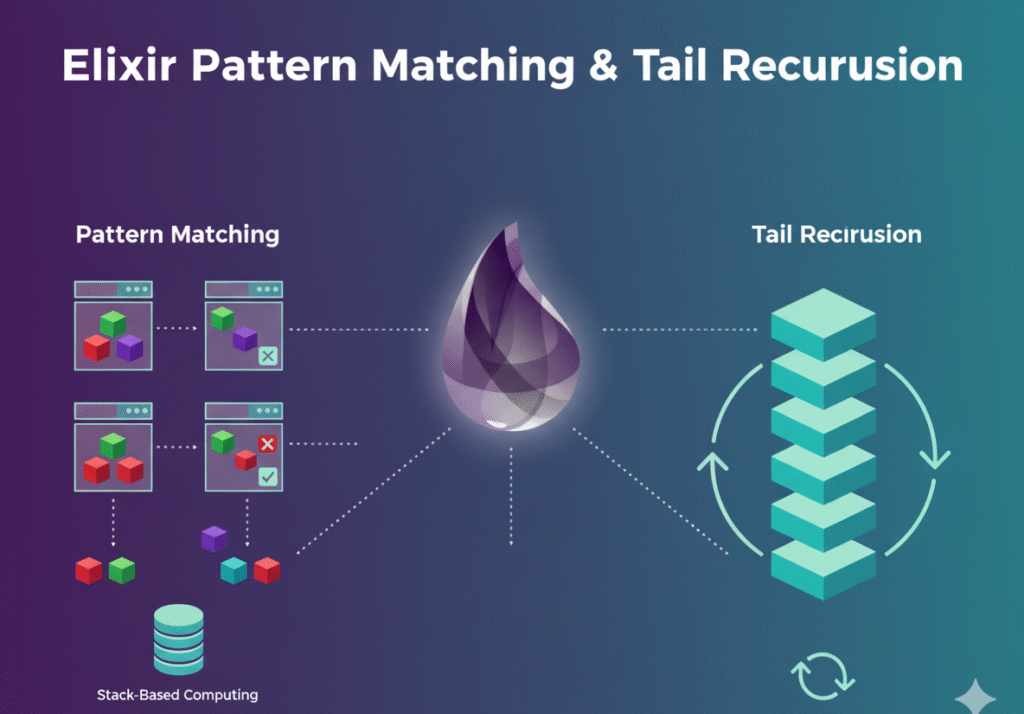
Discover how functional programming paradigms eliminate stack overflow fears and create more elegant, efficient code with the help of Pattern Matching
The Stack Overflow Nightmare
Every developer has been there. You’re working on a recursive algorithm, feeling confident about your elegant solution, when suddenly — STACK OVERFLOW. Your beautiful recursive function just brought your application to its knees because it consumed too much stack memory. In traditional imperative languages, recursion often feels like walking a tightrope without a safety net.
But what if I told you there’s a paradigm where recursion isn’t just safe — it’s the preferred way to iterate? Welcome to the world of functional programming, where languages like Elixir have turned the traditional stack-based execution model on its head.
Understanding the Problem: Stack-Based Recursion
In most programming languages, each function call creates a new frame on the call stack. When you write a recursive function, each recursive call adds another frame, and the stack grows until the base case is reached. Only then do the frames start unwinding.
Consider this traditional recursive factorial implementation:
function factorial(n) {
    if (n <= 1) return 1;
    return n * factorial(n - 1);
}

factorial(5);Code language: JavaScript (javascript)
Above implementation creates 5 stack frames, here’s what happens in memory:
Stack grows →
factorial(5) → 5 * factorial(4)
factorial(4) → 4 * factorial(3)
factorial(3) → 3 * factorial(2)
factorial(2) → 2 * factorial(1)
factorial(1) → 1 (base case)
← Stack unwinds, multiplying valuesCode language: Markdown (markdown)
Each frame must be preserved because the multiplication happens after the recursive call returns. For large inputs, this quickly exhausts available stack space.
Now let’s see how functional programming’s pattern matching helps here.
Enter Pattern Matching: The Functional Programmer’s Swiss Army Knife
Pattern matching is one of functional programming’s most powerful features. Unlike traditional conditional statements that check values, pattern matching allows you to destructure data and bind variables in a single, elegant expression.
In Elixir, pattern matching works by attempting to match the shape and values of data structures:
# Basic pattern matching
{:ok, result} = {:ok, 42}
# result is now bound to 42

# List pattern matching
[head | tail] = [1, 2, 3, 4]
# head = 1, tail = [2, 3, 4]

# Function clauses with pattern matching
defmodule Math do
  def factorial(0), do: 1
  def factorial(1), do: 1
  def factorial(n) when n > 1, do: n * factorial(n - 1)
endCode language: Elixir (elixir)
Now you’ll think above code still has the stack frames problem, and you are right, so we have one more pattern which is called tail-recursion let’s see it
The Tail Recursion Revolution
Tail recursion occurs when the recursive call is the very last operation in a function — there’s no additional computation after the recursive call returns. This allows the compiler or runtime to optimize the recursion into a simple loop, reusing the same stack frame.
Here’s how we transform our factorial function using tail recursion and an accumulator.
defmodule TailRecursive do
  def factorial(n), do: factorial(n, 1)

  # Private tail-recursive function with accumulator
  defp factorial(0, acc), do: acc
  defp factorial(n, acc) when n > 0 do
    factorial(n - 1, n * acc)
  end
endCode language: Elixir (elixir)
Let’s trace through factorial(5):
Call: factorial(5, 1)
Call: factorial(4, 5)    # 5 * 1 = 5
Call: factorial(3, 20)   # 4 * 5 = 20
Call: factorial(2, 60)   # 3 * 20 = 60
Call: factorial(1, 120)  # 2 * 60 = 120
Call: factorial(0, 120)  # 1 * 120 = 120
Return: 120Code language: JavaScript (javascript)
Here above if you notice, we don’t have issue of the stack buildup, each call is returning the result immediately.
Elixir’s Pattern Matching Superpowers
Elixir takes pattern matching to the next level, making tail recursion not just possible but beautiful. Let’s explore some practical examples:
Example 1: List Processing
defmodule ListProcessor do
  def sum(list), do: sum(list, 0)
  def sum([], acc), do: acc

  # Recursive case: pattern match head and tail
  def sum([head | tail], acc) do
    sum(tail, head + acc)
  end
end

iex> ListProcessor.sum([1, 2, 3, 4, 5])
15Code language: Elixir (elixir)
Example 2: Tree Traversal
Let’s see while iterating a tree, how pattern matching makes it way easier
defmodule TreeTraversal do
  defstruct [:value, :left, :right]

  def sum_tree(nil, acc), do: acc
  def sum_tree(tree), do: sum_tree(tree, 0)

  # Pattern match on tree structure
  def sum_tree(%__MODULE__{value: val, left: left, right: right}, acc) do
    acc
    |> sum_tree(left, val + acc)
    |> sum_tree(right, _)
  end
endCode language: Elixir (elixir)
Example 3: Advanced Pattern Matching with Guards
defmodule NumberProcessor do
  def process_numbers(numbers), do: process_numbers(numbers, [])

  def process_numbers([], acc), do: Enum.reverse(acc)

  def process_numbers([n | rest], acc) when rem(n, 2) == 0 do
    process_numbers(rest, [n * n | acc])
  end

  def process_numbers([n | rest], acc) when rem(n, 2) == 1 do
    process_numbers(rest, [n * n * n | acc])
  end
end

iex> NumberProcessor.process_numbers([1, 2, 3, 4, 5])
[1, 4, 27, 16, 125]Code language: Elixir (elixir)
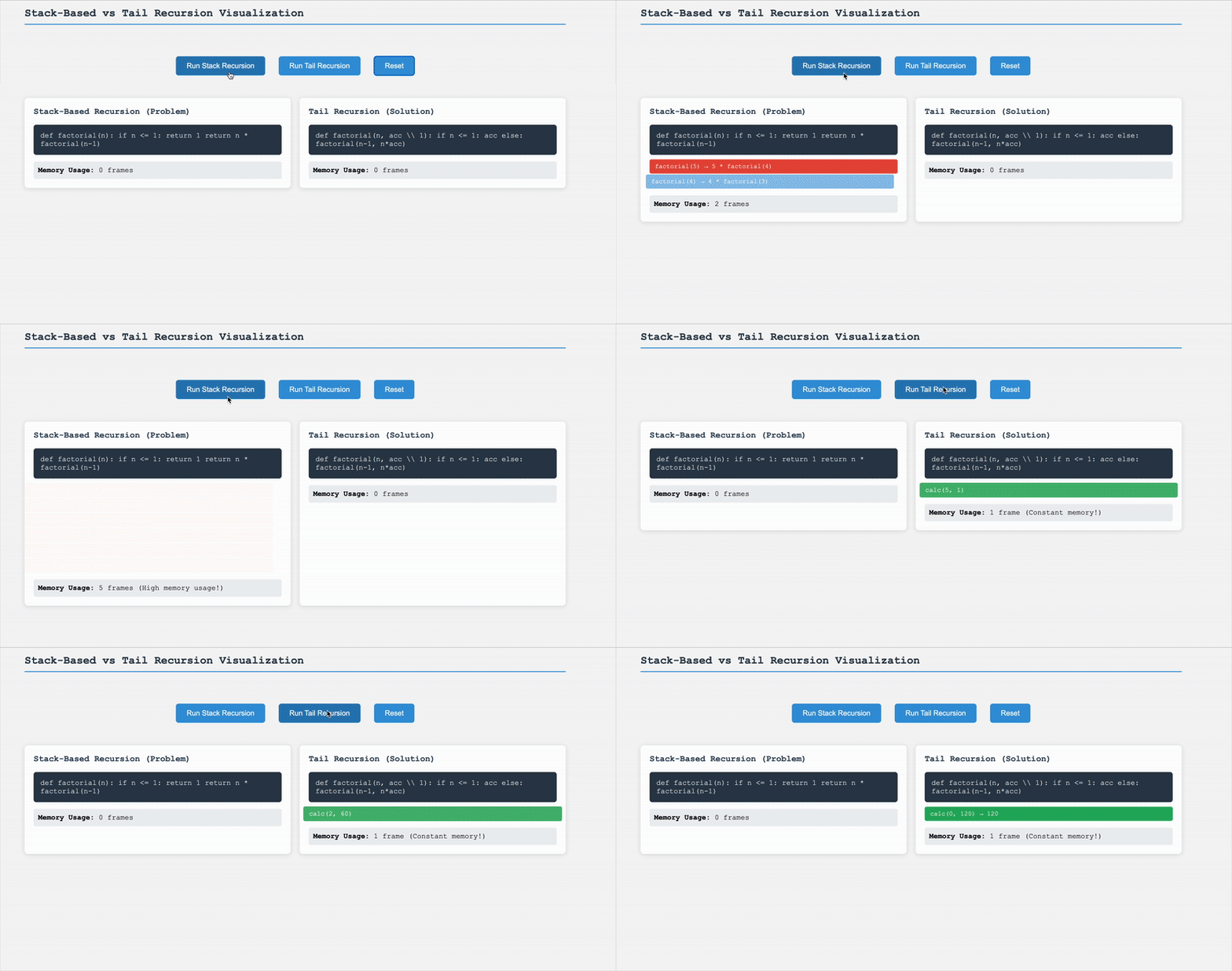
Visual Comparison: Stack vs Tail Recursion
Let’s see visually how they are in comparison to each other
Why Elixir Excels at This Pattern
Elixir, built on the Erlang Virtual Machine (BEAM), is specifically designed for this kind of programming. Here’s why it excels:
1. Tail Call Optimization (TCO)
The BEAM virtual machine automatically optimizes tail calls, converting them into jumps rather than new stack frames.
2. Immutable Data Structures
Since data can’t be modified, there’s no need to preserve state across function calls, making tail recursion natural.
3. Pattern Matching as a First-Class Feature
Pattern matching isn’t an afterthought — it’s built into the language’s core, making complex data destructuring elegant and efficient.
4. The Actor Model
Elixir processes are lightweight and isolated, each with their own stack. This makes stack overflow in one process impossible to affect others.
Real-World Performance Comparison
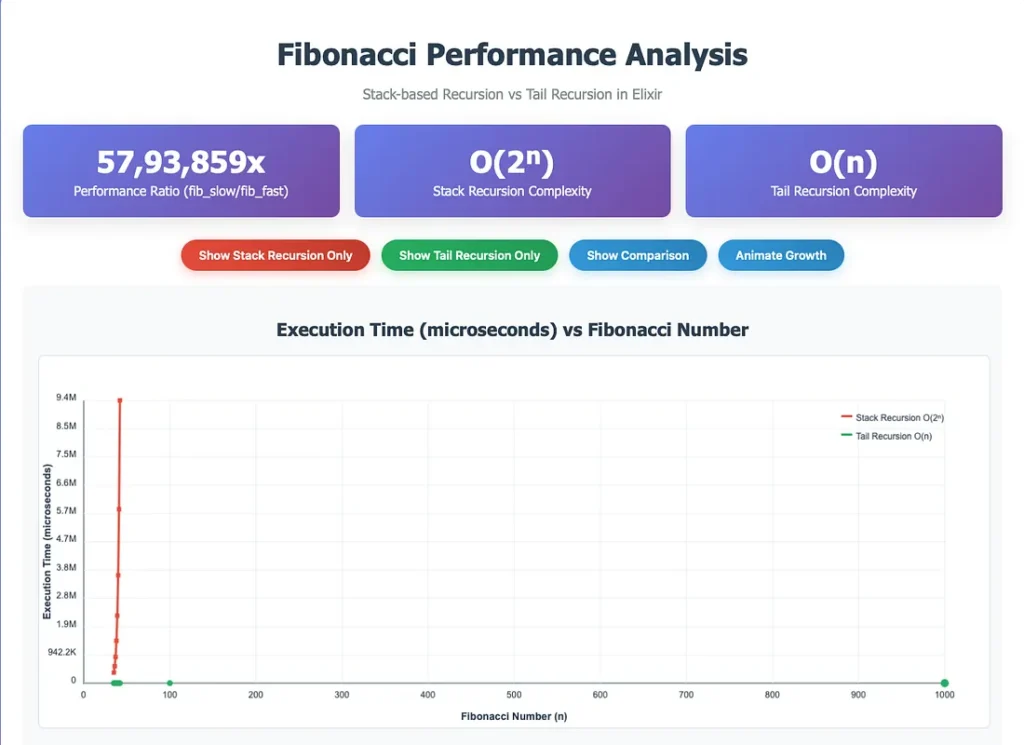
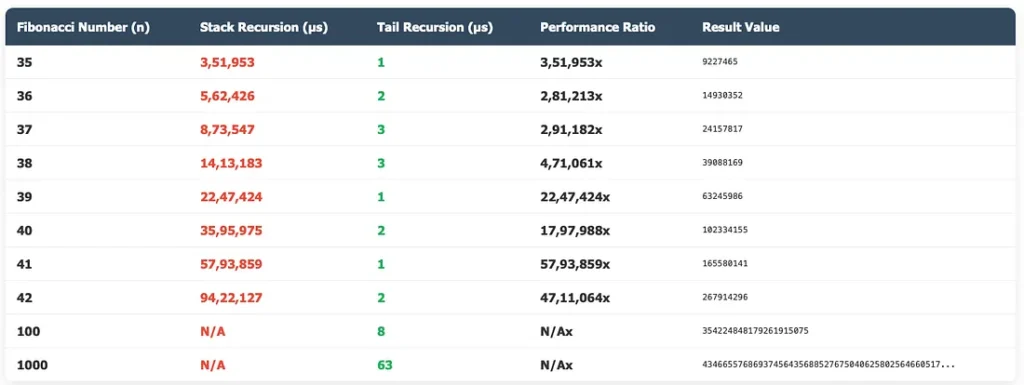
Let’s see the difference in action with a more complex example — finding the nth Fibonacci number:
defmodule FibonacciComparison do
  # Stack-consuming version (Please DON'T USE THIS)
  def fib_slow(0), do: 0
  def fib_slow(1), do: 1
  def fib_slow(n), do: fib_slow(n-1) + fib_slow(n-2)

  # Tail recursive version with accumulator
  def fib_fast(n), do: fib_fast(n, 0, 1)

  def fib_fast(0, a, _b), do: a
  def fib_fast(n, a, b), do: fib_fast(n-1, b, a+b)
end
Code language: Elixir (elixir)
The tail-recursive version is literally millions of times faster and uses constant memory!
Advanced Pattern Matching Techniques
Elixir’s pattern matching goes far beyond simple value comparisons:
De-structuring Complex Data
defmodule DataProcessor do
  def process_user_data(users), do: process_user_data(users, [])

  # Pattern match on user maps with specific structure
  def process_user_data([], acc), do: Enum.reverse(acc)

  def process_user_data([
    %{name: name, age: age, email: email} = user | rest
  ], acc) when age >= 18 do
    processed = %{user | email: String.downcase(email)}
    process_user_data(rest, [processed | acc])
  end

  # Skip users under 18
  defp process_user_data([_user | rest], acc) do
    process_user_data(rest, acc)
  end
endCode language: Elixir (elixir)
Binary Pattern Matching
defmodule ProtocolParser do
  def parse_packets(data), do: parse_packets(data, [])

  def parse_packets(<<>>, acc), do: Enum.reverse(acc)

  # Pattern match binary data
  def parse_packets(<<
    type::8,
    length::16,
    payload::binary-size(length),
    rest::binary
  >>, acc) do
    packet = %{type: type, length: length, payload: payload}
    parse_packets(rest, [packet | acc])
  end
endCode language: Elixir (elixir)
The Functional Programming Mindset Shift
Moving from imperative to functional programming with pattern matching requires a fundamental mindset shift:
Imperative thinking: “How do I change this state step by step?”
Functional thinking: “How do I transform this data from one shape to another?”
Instead of loops and mutations, you think in terms of:
- Data transformations through function pipelines
- Pattern matching to destructure and route data
- Accumulators to build up results
- Tail recursion to process collections
Conclusion: Embracing the Pattern
Pattern matching combined with tail recursion isn’t just a neat trick — it’s a fundamental paradigm that makes code more:
- Reliable: No stack overflow worries
- Readable: Intent is clear through patterns
- Performant: Constant memory usage
- Maintainable: Functions are pure and predictable
Elixir takes these concepts and makes them not just possible, but joyful to use. The BEAM VM’s optimization combined with Elixir’s elegant syntax creates an environment where recursive thinking becomes natural and efficient.
The next time you’re tempted to reach for a loop, consider reaching for pattern matching and tail recursion instead. Your future self (and your stack) will thank you.
Ready to dive deeper into functional programming? Start experimenting with Elixir’s pattern matching in small doses. Begin with simple list processing functions and gradually work your way up to more complex data transformations. The patterns you learn will change how you think about programming forever.
If you liked the blog, please consider buying me a coffee https://buymeacoffee.com/y316nitka Thank You!